CoSt Share Program
Cost Share Program
Cost Share Application - Cost Share Application.pdf
Process outline- Cost Share Process Outline.pdf
ATCP 50: https://docs.legis.wisconsin.gov/code/admin_code/atcp/020/50
Land and Water Resource Management Cost-Share program provides technical and financial assistance to landowners to install conservation practices in order to improve soil health, protect and improve water quality, and conserve the natural resources of Forest County. Goals to address natural resource concerns and an implementation strategy to achieve those goals are established in the 2017-2026 Land and Water Resource Management (LWRM) Plan which is updated every ten years.
Landowners who are interested in obtaining cost-sharing to install a conservation practice on their land should contact us. If a project is eligible, landowners may receive cost-sharing of 50%, 70%, and even up to 90% towards the installation of conservation practices.
Healthy Lakes & Rivers
Healthy Lakes & Rivers Program
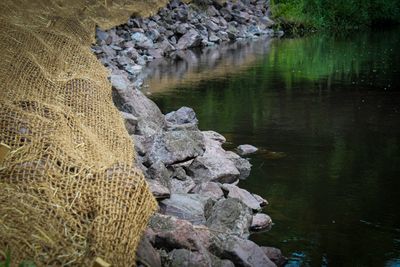
Healthy Lakes & Rivers includes 5 simple and inexpensive best practices that improve habitat and water quality on your shoreland property. Check out the best practices, supporting technical guidance, and other information to install a project on your own. Alternatively, the Wisconsin Department of Natural Resources has competitive Healthy Lakes & Rivers grants for eligible applicants like local units of government, qualified lake or river organizations, and others who can apply for funding on behalf of shoreland property owners. For questions check out their website or reach out to Lucas O’Brien.
Website: https://healthylakeswi.com/

Nutrient Management Planning
Nutrient Management Planning
Nutrient management refers to the use of manure and other fertilizers to meet crop nutrient needs, while reducing the potential for run-off from fields to lakes, streams and groundwater. Nutrient management helps assure that crops receive the right amount of nutrients (nitrogen, phosphorus and potassium, often referred to as N-P-K) at the right time and precisely where the farmer intends. This benefits the farmer by improving crop yields and reducing costs, and benefits the environment by keeping nutrients on the fields and preventing run-off to lakes, streams, and groundwater.
In Wisconsin, all farms should have a nutrient management plan. Some farms will follow a nutrient management plan if they:
- Are offered cost-sharing to develop a plan
- Accept cost-sharing for manure storage systems
- Are large livestock operationsthat require a Wisconsin Pollutant Discharge Elimination System permit

Invasive Species
Invasive Species work in Forest County
Invasive species are when non-native plants, animals, or pathogens rapidly takes over a new location and alter the ecosystem. When a non-native species is brought into a new area, the species may take over and spread rapidly and widely throughout the area. The spread of the non-native species can cause major harm to the native ecosystem or humans.
One of the reasons that invasive species are able to thrive is due to the fact they often leave their predators and competitors behind in their native ecosystems. Without these natural checks and balances, they are able to reproduce rapidly and out-compete native species.
Invasive plants, animals and pests are taking a toll on Wisconsin's lakes, rivers and landscapes. Forest County is working with citizens and partners to slow the spread of invasive species. Through educational outreach, strategic planning and active management we are protecting our environment and economy from invasive species.
Forest County’s AIS Coordinator is Derek Thorn, you can find his website here: https://lumberjackrcd.org/flow-ais-program
Forest County is also apart of a CISMA knows as the Wild Rivers Invasive Species Coalition, their website is linked here: https://www.wrisc.org/

Non mEtallic Mining Reclamation
Non Metallic Mining Reclamation
Who needs this permit? Anyone who excavates, dredges, grades, drills or blasts for naturally occurring, non-renewable materials such as: stone, sand, gravel, topsoil, asbestos, beryl, diamond, clay, coal, feldspar, peat, marl or talc.
New mines: Any new non-metallic mine needs to apply for conditional use permit through the Forest County Zoning Department. The conditional use permit application will need to comply with all requirements of All required information must be submitted prior to beginning operations.
Exemptions:
· The site is less than an acre over the life of the operation.
· For domestic or farm use only at the person’s residence or farm.
· Excavation or grading solely for the development of construction sites and/or for the construction of buildings.
· Excavation near navigable waters regulated under DNR Chapter 30 permits.
· Operations that are subject to the reclamation requirements of the Department of Transportation.
What is required?
1. A plan for reclaiming the land to a designated land use (Plan review fee - $250.00). Plans must meet or exceed detailed statewide standards. For additional information on reclamation standards, refer to the Forest County Non-Metallic Mining Ordinance. In general terms, the standards address the following issues:
- Minimization of active mined area
- Groundwater and surface water protection
- Restoration of fish and wildlife habitat
- Final grading and slopes
- Topsoil redistribution
- Revegetation and site stabilization
- Public safety and welfare
- Compliance with other environmental regulation
2. A bond or other form of financial assurance, which ensures implementation of the plan if the pit operator defaults. At least $3,000 per acre.
3. Annual permit fees based on acreage of unreclaimed land, which is land that is actively used for extraction; material preparation, processing and storage; refuse piling; hauling; topsoil stockpiling; and other activities necessary to extraction and processing. Fees are not charged for undisturbed areas of proposed mining or reclaimed areas.
Application: OfficialNMMapplicaton.pdf
New Application Procedure: New Application Procedure.pdf
Reclamation Plan Checklist: Reclamation Plan Checklist NR135, Forest County.pdf
Forest County Non-Metallic Mining Ordinance: Forest County Non Metallic Mining Ordinance, 2007.pdf
Chapter NR 135: https://docs.legis.wisconsin.gov/code/admin_code/nr/100/135
Contact Info: Kayla.L@co.forest.wi.us or 715-478-1387
